I attended Mooseman: a precompression Burning Man regional event. Five days of survival camping in the forest of Haliburton. No water. No electricity.
The first 36 hours of the event were like a roller coaster of new experiences - both positive and negative, both personal and interpersonal. The first night I met some truly lovely people around a very large fire held in a large circle of stones. The following day I experienced a few interactions that were less than ideal. My physical challenges were brought home to roost and I considered leaving in case they worsened. The team of onsite Rangers helped mediate what was a challenging and baffling situation for me and I ended up staying due to their support. Two of the 10 Burning Man principles were driven into me throughout the beginning part of my experience at Mooseman: Radical self-reliance and Radical inclusion.
On the Saturday of the event after I had rested (I was exhausted from the emotional roller coaster and physical demands of survival camping set up!) I ventured back to the sacred circle. I was told that there was garlic braiding down at the main house (the owner of the property) and that it was a lot of fun. I decided I would rather take a walk through the forest which was set up with four theme camps and I wanted to see what they looked like in their finished state (I saw the skeletons of these camps on a Thursday night walk about).
The effort put into these theme camps is dumbfounding and humbling. One of the camps, Powder Monkeys, had a pirate theme and the decorations and plounges were so creative. This camp also hosted a Baconade on the Sunday morning and everyone who participated in that achieved Peak Bacon. There were two types of bacon, bacon dip, bacon brownies, bacon apple pie, bacon/cheese roll-ups, bacon chocolate chip rice krispies, etc.
On the way into the forest there was a Toga Toll Camp. These lovely people provided a candy tray that they also took throughout the event at times. There was bug spray on offer and other provisions if needed. Did I mention that all Burning Man events operate on a gift economy basis? No money exchanges hands. Every participant is expected to gift what they can and high octane volunteerism is the norm.
I didn't spend as much time as I would've like to at the Big Rig Rockin Robin's Truck Stop Jamboree. They had built a replica of a truck complete with a truck stop diner and a country store that I shoplifted a pocket knife from (I had lost mine). They had some fine trombone jamming happening on Saturday night when I was there.
Lastly there was a Hammock Camp at the end of the forest trail. Peace and tranquility was found in one of the hammocks hanging there :)
On Sunday afternoon after dancing in the forest for a few hours to some wonderful beats I remembered the garlic braiding and wandered down to the main house (past the coffee cafe which served delicious free coffee all weekend long!). Outside of the house was a circle of chairs and instruments of garlic disorder. I stood and asked the three people about what was going on and shared a bit of my food justice passion with them. Doug, the owner of the property, saw a fellow food spirit and he eagerly invited me to sit down and try cleaning some garlic myself. Silvie, another Mooseman attendee, patted a chair and proceeded to show me how to clean the garlic (rub the stalk and bulb with love to remove the dirt, trim the hairy end and brush out the dirt). In the course of learning this new skill, Doug, Silvie, another young man and I got into a wonderful conversation that alternated between philosophy, therapy, camaraderie and hilarity.
After a few minutes of this pleasant learning - interactive engagement Doug became perturbed while I was talking. I wasn't staying on task since I use my hands while I talk. He told Silvie to take me down to the shed to see the enormity of the garlic cleaning task at hand.
Have you ever seen 1700 bulbs of garlic in various stages of 'processing'? Doug had already informed us that it takes 20 passes through human hands to fully process garlic (now you know why most of it comes from China since it is so labour intensive!). So when I rounded the corner into the shed I saw how massive the operation was and how many uncleaned bulbs there were - well, that was when the disorder struck me.
I returned with Silvie and spend the next few hours mastering the art of conversing while cleaning garlic bulbs at a steady rate. I was rewarded with a fine meal from Lynn (Doug's partner) that included potatoes freshly harvested from their garden and the opportunity to braid my very own set of bulbs which I later purchased on my way out of the event. The ideas, love, inspiration and garlic imbued soulfulness of the experience will last my lifetime. In fact, the whole weekend will. The final of the 10 principles of Burning Man was cemented into my heart that afternoon and sealed with the burning of the Moose effigy that night:
Immediacy
Immediate experience is, in many ways, the most important touchstone of value in our culture. We seek to overcome barriers that stand between us and a recognition of our inner selves, the reality of those around us, participation in society, and contact with a natural world exceeding human powers. No idea can substitute for this experience. (source)
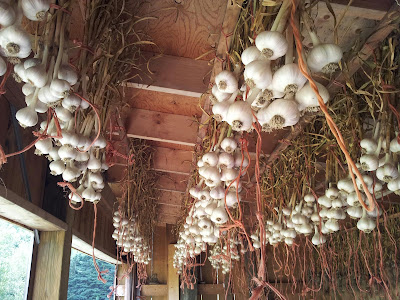 |
| Unbraided but cleaned fruits of our Obsessive Garlic Disorder |


